

The trademarked phrase uttered each April, “A tradition unlike any other” is synonymous with the Masters, a golf tournament that has been played since 1934. This is a tournament that spans nearly a century and feels like something that has been played forever. In perspective, the Owatonna Country Club is 15 years its elder, having laid down its storied roots in 1919.
The OCC footprint looked quite different when it was founded some 105 years ago. Just two years prior to OCC’s inception, the United States was entering World War I.
For those familiar with local history, the largest free fair in the state of Minnesota (Steele County Free Fair) was opening its gates for the first time in 1927.
In its infancy in 1919, OCC was a nine-hole endeavor. The current Lake Kohlmier was merely a corn field while the greens were made of sand, which was commonplace at the time. Of the original greens from 1919, two of them remain on the 2024 scorecard (No. 8 and No. 10).

After opening in 1919, OCC did not experience its first major changes until the 1950s. It was at this time when 10 acres south of its original imprint was purchased and new hole layouts were put into motion. In 1956, the revised design was rolled out to its members and many hole numbers were amended, leading into the spring of 1960.
As of now, the only way to traverse the course was on foot, occasionally utilizing the walking bridges across the Straight River – a body of water that would persist as an ongoing challenge for OCC. It was not uncommon for OCC to be closed for weeks a time waiting for the waters to recede into their banks.
Most Owatonnan’s are accustomed to OCC being an 18-hole scorecard. This transition happened in OCC’s history in 1973. As OCC continued to grow, it hired PGA professional Joel Goldstrand of Minneapolis to serve as the architect that would direct these efforts. New holes were built to supplement the nine existing holes and the new 18-hole renovation proudly opened that spring.
These 18 holes were what I remember playing in the mid 1990s as an adolescent. OCC was deceptively challenging at the time, not due to the overall course distance, but rather the greens. The greens were (and still are) what make OCC difficult to successfully navigate. The smaller greens are difficult to read due to the varying style of greens that comprised the 18-hole layout. This coupled with consistently high stimpmeter readings was recipe for a dicey challenge.
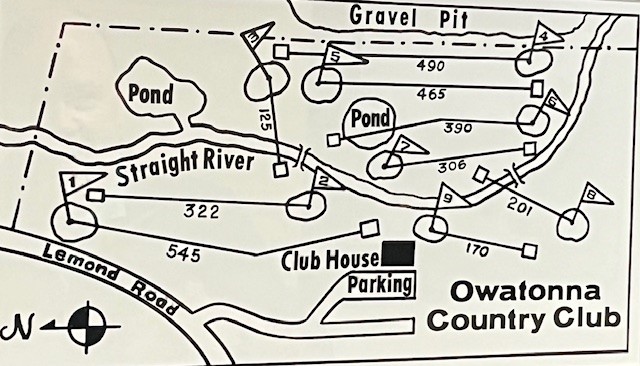
OCC would see a major project spearheaded by Barr Engineering in the late 1990’s/early 2000’s which helped combat the rising waters that the course would experience during flooding conditions. In prior decades, OCC could be closed for weeks and months at a time due to the Straight River exceeding its banks. However, Barr helped step in during the turn of the century. This expansive excavation work created new wetland areas and drainageways for floodwaters, allowing OCC to forge ahead with flooding closures being largely alleviated. The course would still see times with wet areas and rounds where carts were not allowed. However, in the rearview mirror were the days of closing the club for weeks at a time due to floodwaters.
While these major changes were occurring on the course, the original clubhouse was also seeing new beginnings. The initial clubhouse, built in 1919 and added onto in 1920 and 1960, was burned down as part of a controlled burn training exercise in connection with countless fire departments in the area. In the absence of a clubhouse and in the midst of course construction, the show went on. A tent was set-up in the parking lot so members could check in and the new (and also existing) clubhouse was able to open its doors in 2003.
The fifth and final rendition to the OCC layout (to date) happened just a few years later when MnDOT announced a major upgrade of Highway 14 and Interstate 35. This interchange work on the far south end of OCC resulted in major changes to holes two and three. After this project came to fruition, the layout of today has remained essentially constant.
OCC has and will continue to make the necessary changes and adaptions to successfully forge into the future. With OCC’s strong history as its backbone, the future looks bright for southern Minnesota’s diamond in the rough.
A special thank you to Founding Member Tom Shea and current OCC General Manager Dan Jacott for their hospitality and help in navigating the details and pictures of this column.
Until next month, hit ‘em long and straight – and most of all have fun!







 THE HUSKY BULLETIN