


Alright, I’m going to just come out and say it: Albert Lea doesn’t belong in the Big Nine Conference.
That’s right, I believe one of the founding members of a league that dates back nearly 100 years needs to find a new home, and soon.
Allow me to elaborate.
Albert Lea — which, along with Austin, Owatonna, Faribault, Mankato, Red Wing, Rochester and Winona, joined forces in 1928 to form the precursor to the modern Big Nine Conference known initially as The Big Eight — has become hopelessly buried at the bottom of the 12-team league and appears to have little hope of clawing out of its current predicament. The reason, or reasons, for the Tigers’ struggles are vast, complex and wide-ranging. They’re also not something that can be be properly explored in a single editorial, so I’ll leave that essay for another time.
I will, however, attempt to put a few key points into perspective and contextualize some of the raw data that has been mounting against the Tigers for years and forged a rather daunting situation for the school’s entire athletic department. I’ll also explore how this dichotomy has effected the overall competitive balance of the Big Nine Conference.
Quite simply, Albert Lea is losing the game on the field because its losing the game against the numbers.
COMPETITIVE SPORTS, A NUMBERS GAME
Let’s start by exploring Albert Lea’s enrollment and go from there. According to the latest data released on March 1, 2023 by the Minnesota State High School League, the school has an adjusted, or competitive, enrollment of 760 students. Before we move on, it’s important to understand how this number was generated and where Albert Lea stands within the Big Nine as a whole, because it’s not as straightforward as you might expect.
Far from it, actually.
Determining each school’s MSHSL enrollment for classification purposes involves a somewhat convoluted process that I will attempt to distill into a few neat paragraphs right here: Defining a school’s MSHSL enrollment is accomplished by applying a systematic formula that begins by taking a school’s “actual enrollment” as compiled by the Minnesota Department of Education and subtracting exactly 40% of all students within the school that are part of the state’s free-and-reduced lunch program.
In Albert Lea’s case, its actual 9-12 enrollment per the MDE at the beginning of the most recent two-year reclassification cycle was 966, and 53.4% of those students (516) were listed as part of free-and-reduced lunch initiative. In this case, we would then take 516 and multiply that by .40 (40%) to give us a rounded number of 206. That number would then be subtracted from 966 and…viola! You have now unearthed Albert Lea’s MSHSL enrollment of 760 students.
Albert Lea is ninth amongst the dozen Big Nine Conference schools in MSHSL-adjusted enrollment and one of three schools in the bottom third separated by just 19 students.
In prep sports, healthy numbers are essential to healthy athletic programs while low numbers, unsurprisingly, are equally as detrimental. Albert Lea’s stagnant enrollment and surging free-and-reduced lunch population major factors in the Tigers’ severe struggles against Big Nine foes over the last decade-plus. On some level, the same can also be said about similarly-sized Big Nine schools with sub-1,000 enrollments, Red Wing, Winona and Faribault.
In Albert Lea, though, things are especially concerning.
The 2023-24 academic year has been particularly harsh on the Tigers. In the fall, Albert Lea fielded six varsity teams — football, girls tennis, girls swimming and diving, volleyball, boys soccer and girls soccer — and finished with a collective winning percentage of just .073 and combined for three last-place finishes.
Not counting the football team — which finished 1-7 as a member of the South Central-White District — Albert Lea finished no better than 10th place in the final league standings and went winless in two of the six fall sports it sponsored this past fall.
This winter has certainly been more fruitful, but standing in stark contrast to the Tigers’ impressive conference championship in wrestling and second place finish in girls hockey are a trio of teams — boys basketball, girls basketball and swimming and diving — that have failed to win a single league contest and posted a combined 0-39 record as of Feb. 19.
Bottom line, numbers don’t tell the whole story, but they also don’t lie. And truth be told, the Tigers are routinely out-classed, out-manned, out-muscled and, well, out-numbered by opponents hailing from schools with a far deeper pool of student-athletes to choose from when building their rosters, and the gap is widening.
The school standing directly ahead of Albert Lea in the overall Big Nine enrollment standings, Austin, is larger by a sizable 257 students while the biggest of the bunch, Rochester Mayo, dwarfs Albert Lea by 870.
Competitive integrity aside, that type of disparity shouldn’t exist in our current prep sports landscape and quite simply isn’t fair on a number of levels.
It isn’t fair to the majority of the Tigers’ league opponents that are essentially forced into a no-win situation when competing against Albert Lea. I mean, what good does it do for he five Class AAAA and and six Class AAA basketball programs in the the Big Nine Conference to play a Class AA school like Albert Lea1. The answer: None.
| ROCHESTER MAYO | 1,630 |
| ROCHESTER CENTURY | 1,485 |
| ROCHESTER JM | 1,301 |
| OWATONNA | 1,244 |
| NORTHFIELD | 1,102 |
| MANKATO EAST | 1,078 |
| MANKATO WEST | 1,069 |
| AUSTIN | 1,017 |
| ALBERT LEA | 760 |
| WINONA | 746 |
| FARIBAULT | 741 |
| RED WING | 593 |
Most importantly, though, it isn’t fair to the Albert Lea student-athletes. Losing is one thing, but getting physically overwhelmed is another. The constant blowouts, mounting lop-sided losses and perpetual losing streaks were frustrating a long time ago for the Tigers. At this point, it has to feel downright devastating. And high school sports aren’t supposed to feel that way. They’re supposed to offer a healthy avenue for young men and women to learn valuable life lessons in a competitive, fair and rewarding environment.
Yet there’s nothing competitive about being out-scored by an average of 27 points-per-game in conference action like the Tigers’ boys basketball team has endured this season.
There’s nothing fair about having to consistently square off against opponents hailing from schools twice your size.
And, ultimately, there’s nothing rewarding about pulling your starters in the middle of the second half and still winning by 50 points like the Owatonna girls basketball team did against the Tigers earlier this season.
A SIMPLE CONCEPT, A COMPLEX SOLUTION
The easy answer to Albert Lea’s predicament would be for the school to simply leave the Big Nine Conference and apply for a league that better suits it from a competitive, philosophical, geographical and enrollment standpoint.
Alright, so what are some potential options here? Off the top, the Big South Conference checks all the requisite boxes.
The league not only sits within the same geographical footprint as Albert Lea — stretching across a large swath of south-central Minnesota and extending as far west as Pipestone, north to Belle Plaine and east to Blue Earth — but also fits from a numbers standpoint.
As of 2023-24, the 15 schools in the Big South range in enrollment from 255 to 804, which is far more compatible to Albert Lea’s 760 than the increasingly top-heavy Big Nine that has eight schools with at least 1,000 students. If the Tigers were to make such a transition, the school would go from being the fourth smallest in the Big Nine, to the second largest in the Big South.
Furthermore, the Big South also offers sports like hockey, soccer, swimming and diving and tennis — all of which Albert Lea sponsors.
THE EXADUS EFFECT
Hypothetically, if Albert Lea were to leave the Big Nine — and to be clear, this proposal hasn’t been entertained in any official capacity as far as I know — it might compel similarly-sized schools like Winona, Faribault and Red Wing to explore similar options outside the league.
Of the trio, Winona and Red Wing seem to possess the greatest incentive to jump ship, at least on paper. Both are relatively isolated within the current Big Nine Conference map and appear to align nicely on several levels with the Hiawatha Valley League.
The nine schools that make up the HVL are no more than an hour drive from both Winona and Red Wing and boast an average enrollment of 418. By comparison, the Big Nine averages 1,064 students per school. Currently, Winona has an MSHSL enrollment of 746 while Red Wing recently dipped to an all-time low of 593.
As for Faribault, well, the situation is a tad different. Geographically, the school is actually positioned closer to the communities within the South Suburban Conference (Lakeville, Burnsville, Apple Valley, Farmington, etc.) than most of its fellow Big Nine members, but a move to the SCC is simply out of the questions for obvious reasons.
However, if Faribault’s enrollment continues to plumet like it has over the last eight years — dropping from 1,230 in 2017 to its current low of 981 — the Falcons could end up in a similar circumstance as Albert Lea and potentially explore a move to the Big South Conference .
Alright, lets just say the extreme scenario materializes and Albert Lea, Winona, Red Wing and Faribault all exit the Big Nine within the next, say…5-7 years. That would leave the league with eight schools, ranging in enrollment from 1,017 to 1,630. This would essentially solve the current swelling enrollment disparity overnight and greatly reduce the the one-sided interclass contests that currently beset the Big Nine in almost every sport.
And who knows? Maybe the Big Nine would be in position to add a ninth school and make a serious overture to New Prague of the Metro West.
That discussion, however, is for another day.
- The Albert Lea boys and girls basketball teams are now a member of Class AA and housed in a section that features numerous schools with enrollments south of 300 students. Owatonna, meanwhile, competes in a section that features five schools with at least 1,600 students. ↩︎
BIG NINE CONFERENCE STANDINGS (FALL/WINTER)

BOYS BASKETBALL 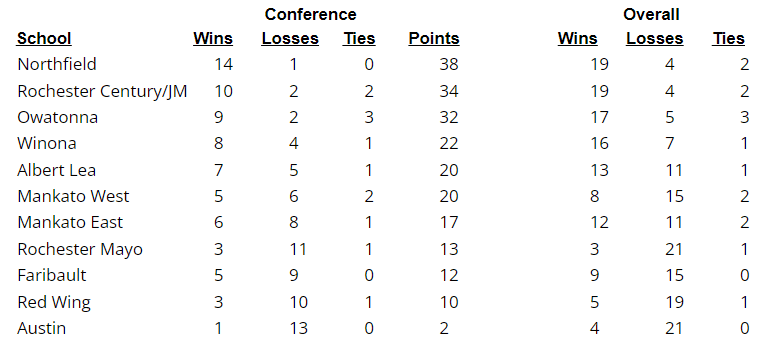
BOYS HOCKEY 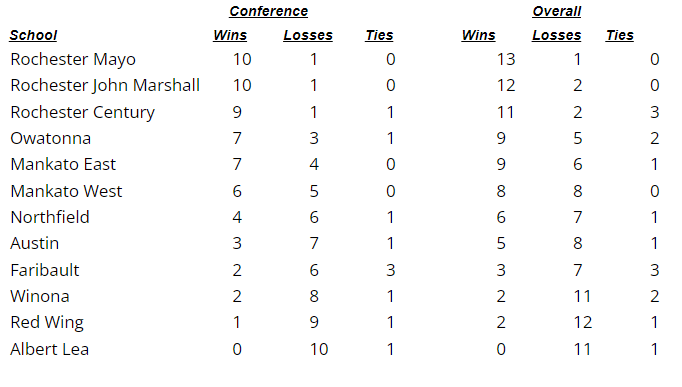
BOYS SOCCER 
BOYS SWIMMING & DIVING 
FOOTBALL 
GIRLS BASKETBALL 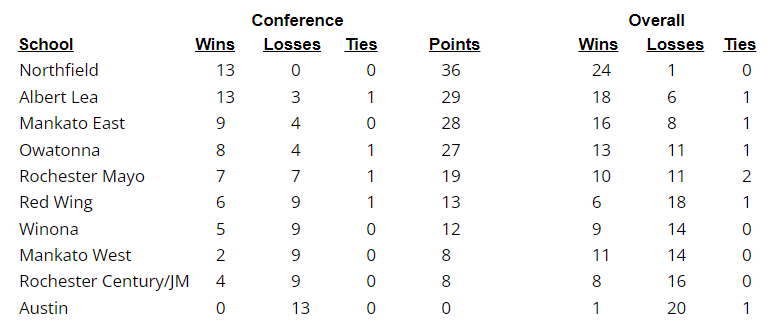
GIRLS HOCKEY 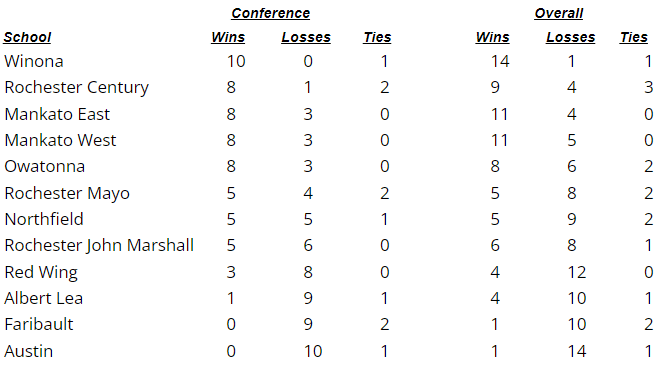
GIRLS SOCCER 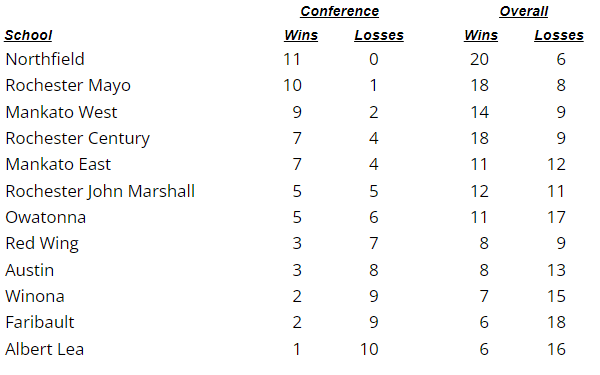
VOLLEYBALL 
GIRLS SWIMMING & DIVING 
GIRLS TENNIS 
WRESTLING






 THE HUSKY BULLETIN
Leave a comment