

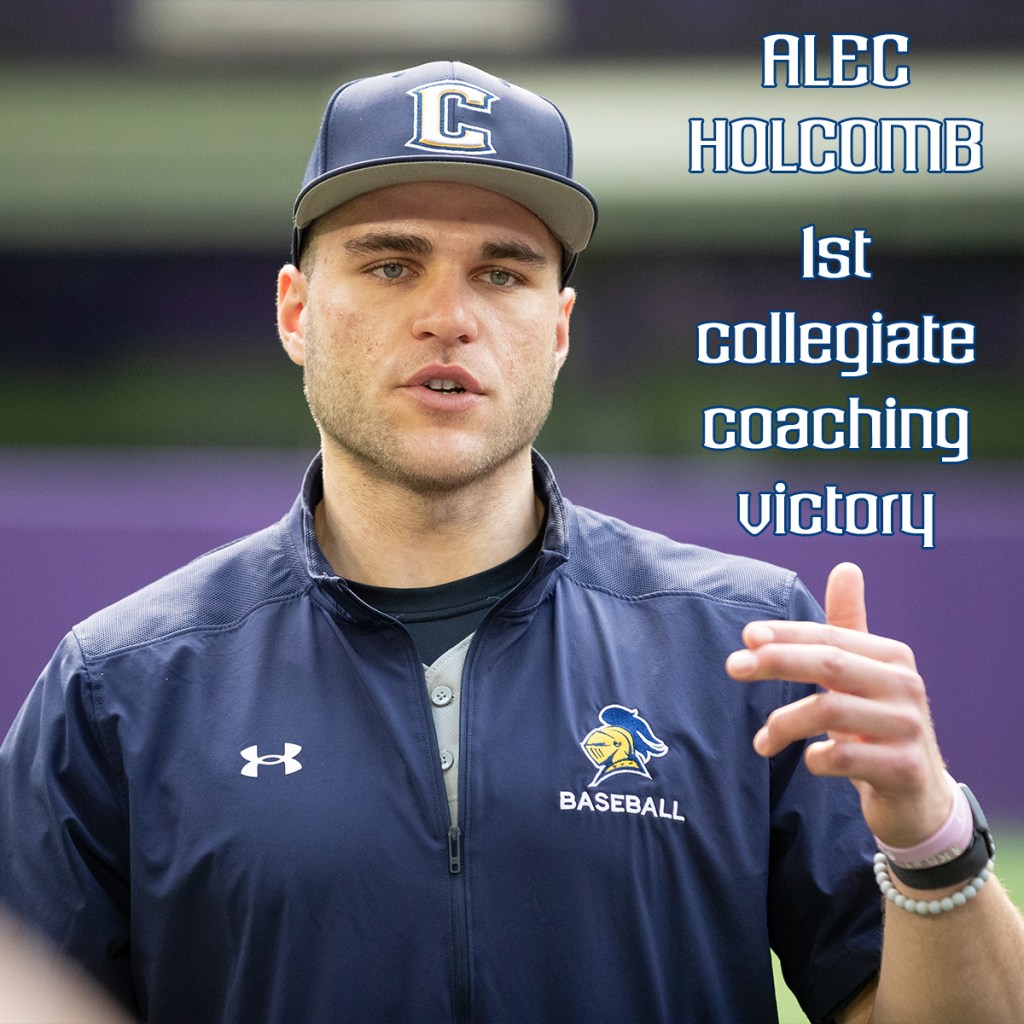
NO. 5 STORYLINE OF 2023
Alec Holcomb chuckled, because there was no way they were serious.
There was no way the group of Carleton College baseball players that stood in front of him truly meant it when they suggested he apply for the team’s vacant head coaching position.
There was no way they honestly believed he was qualified to lead an NCAA athletics program at one of the most prestigious higher learning institutions in the entire country and was equipped to command a large group of ballplayers that were squarely within his own age bracket. Holcomb himself was less than two years removed from his own college playing days and had almost no head coaching experience. Not just at the college level, at any level.
Sure, he had built a strong bond with many of the current Knights’ players during his abbreviated stint as a temporary interim assistant coach for the team last autumn, but that didn’t mean he was ready to become their permanent head coach. That’s not to suggest he wasn’t grateful to answer the call when his friend Mike Ludwig — a former Minor League player and one-time head coach at cross-town rival St. Olaf College — reached out and asked if he would be willing assist at a handful of Carleton practices last September during the NCAA’s temporary offseason training period, because he absolutely was. The 2016 Owatonna High School graduate showed up early each day, stayed late after every practice and offered his support and expertise wherever it was needed.
And that was pretty much it. When it was all said and done, Holcomb was planning on returning home and easing back into his normal daily routine, which mainly included studying for his master’s degree in Coaching and Athletic Administration at Concordia University and working at Velocity Baseball Training in Rochester as the company’s Performance Director.
Quite simply, the concept of taking over as the head coach of a college baseball program wasn’t even a part of his five-year plan at the time. Heck, it wasn’t even a part of his 10-year plan.
“Maybe when I’m 40,” Holcomb joked over the phone last month. “Maybe that’s when I’d be ready. Honestly, I just laughed it off when they first brought it up.”
Though Holcomb humbly deflected the notion and remained casually indifferent on the outside, it was a completely different story just below the surface. He immediately began with a blend of emotions that ranged from shock, to doubt, to excitement, to humility. But, again, ‘There is no way this is going to happen,’ Holcomb thought to himself as the conversation wrapped up.
‘There is no way they are serious about this,’
As it turns out, they were completely serious. All of them. And the players weren’t going to allow him to leave without promising to sleep on it for at least one night and give it some serious consideration over the next couple days. Holcomb ultimately agreed to extend that courtesy, but respectfully explained that the odds of him receiving even a second interview for the job were extremely low. As for the chances that he’d garner an official offer, well, those were even more remote, probably existing somewhere just north of zero and a tad south of doubtful.
“I told (the players) I’d think about it and basically got in my car and drove home,” Holcomb said. “I thought about it the entire time and it stayed in the back of my mind for quite a while. I couldn’t shake it.”
As he mulled things over, Holcomb found himself coming up with far more reasons why he should pursue the opportunity opposed to excuses why he shouldn’t. He started contemplating his future in the sport and reflecting on a unique baseball journey that saw him evolve from a power-hitting, left-handed catcher growing up in Owatonna into a hard-throwing, right-handed relief pitcher during a well-traveled, five-year post-high school career that featured three different stops at three different levels of the college game.
There was also just something about his conversation with the Carleton players that resonated with Holcomb. Their passion for the game was palpable and their loyalty to the program was richly evident, all of which danced in his mind as he contemplated what to do next. His goal had always been to take over his own college program one day, but did that mean it had to be right now? With this team? With this program? Was this the opportunity?
Was this really going to happen?
“No,” Holcomb said. “Absolutely not. There is no way I would have ever thought I’d be in this position at this point in my life if you asked me just a month ago.”
Despite his initial trepidation, Holcomb threw his proverbial cap into the ring and officially applied for the position. He figured he had nothing to lose and was content to simply view the situation as a unique learning opportunity and a chance to receive an up-close perspective to one of the many facets of the sprawling college athletics landscape.
At worst, he could sharpen his interview skills.
At best, well, that scenario was about to unfold in front of his very eyes.
“I have always been confident in my abilities as a coach, but I was the youngest candidate and didn’t have the coaching resume of some of the other guys,” he said. “There was something like 20 (initial) candidates and I just saw it as a great opportunity to get some hands-on experience.”
Holcomb was eventually contacted by the school and took part in the first round of virtual interviews, spending most of the call introducing himself to a small group of high-ranking individuals from various departments at the school and chatting with Carleton Athletics Director, Gerald Young.
It was after this 30-minute conversation that Holcomb admits his entire mindset changed.
“I just knew that at that point if they decided to roll the dice, I’d be ready,” he said. “I can remember thinking to myself that I could seriously see myself doing this (and) I started to formulate a plan and laid out how I would run the program if I got the job.”
In the timeframe directly following his initial interview, things progressed faster than Holcomb ever could have imagined. The first few winter months flew by in a whirlwind of phone calls, meetings, presentations, visits, handshakes, road trips, meals, discussions, and tours.
By the time mid-December rolled around, Holcomb sensed the administration was nearing a decision and his confidence remained unwavering, though he never allowed it to overcome his mindfulness of the present. When the moment finally came around and Young reached out to extend a formal offer, Holcomb found himself viewing it as a culmination of a profound experience rather than a resolution of a formal process.
On December 30, 2022, Carleton College announced that Alec Holcomb had accepted the position to become the school’s next head baseball coach, releasing the following statement on the baseball team’s official Twitter account: “Carleton baseball is excited to announce that Alec Holcomb has been named as the new head coach of the program! ‘I am beyond excited to join such a prestigious college in Carleton,’ said Holcomb. ‘I hope to see everyone out at Mel Taube Field this spring to cheer on the Knights!’”
And with that, history had been made.
Not only had Holcomb become one of the youngest head coaches to ever be hired at Carleton, but at the ripe old age of 24 years, 8 months, and 27 days he officially became the youngest coach amongst all 962 combined NCAA college baseball programs at the Division I, II and III levels, taking over.
“It’s been crazy, that’s for sure,” Holcomb said before taking a deep breath and continuing. “After the final in-person meeting I felt confident, but you just never know. I knew the players were supportive and hearing their experiences with the sport was something that resonated throughout the process and, ultimately, they were looking for a coach with my background and decided to offer me this opportunity. I would have to say there is a less than zero chance that I would have even been considered without the connection piece. I wouldn’t be here without all the people who helped along the way.”
Outside of learning where the bathroom was and figuring out which key worked with which door, Holcomb’s first order of business after moving into his new office on Jan. 9 was to solidify his assistant coaching staff, which can be a tricky procedure at the Division III level, regardless of how many years, or weeks, the coach has under his belt. That’s because assistant baseball coaches at the D-III level are compensated via annual stipends and year-to-year retainment isn’t guaranteed, so turnover is heavy across the board.
“I knew I had to fill those voids right away,” Holcomb said. “I wanted to find guys with the same vision but could also bring different perspectives to the table.”
Holcomb — who began his post-prep playing career at Des Moines Area Community College before moving on to D-I North Dakota State University for two seasons and, eventually, D-II Concordia-St. Paul for his final year — understands as much as anyone that baseball is a sport of distinct technical expertise and used a pragmatic approach to formulate an initial list of candidates and ultimately pinpointed a select few individuals who were not only ultra-qualified from a coaching standpoint, but possessed complementary areas of expertise and experience to his own.
One of the first people he reached out to was long-time Owatonna baseball coach, and school psychologist, Brian Price, and the latter quickly committed to become the Knights’ new top assistant pitching coach. For the final two official spots on the staff, Holcomb lured a pair of former prolific ballplayers in Division II standout, Nate Van Roekel, and one-time Rochester Mayo star and Division I outfielder at the University of Illinois, Michael Michalak.
Originally from New Ulm, Van Roekel currently resides in Owatonna and played at Winona State University where he garnered multiple all-conference accolades in the NSIC before graduating from college in 2013. His connection with Holcomb runs deep as the pair played together for multiple seasons in the summer on the Dundas Dukes amateur baseball team.
“Nate has been around the game for so long and was excited to help out in any way he could,” Holcomb said. “Originally, he said he could be there a couple days a week and probably make most of the away games. Then it was three days a week. And then four. Before long, he had committed to being around for the majority of the practices and traveling with the team to every game.”
As for Michalak, he competed against Holcomb for years at Rochester Mayo and emerged as one of the top ballplayers in the Big Nine Conference around the same time as Holcomb in 2015 and 2016. By the time the pair became teammates at DMACC, they’d each built a healthy respect for one another and instantly clicked. Not only did Michalak fasten a successful two-year career playing in the Big Ten Conference — posting a .276 batting average and accumulating more than 300 plate appearances for the Illini in 2018 and 2019 — but spent two summers playing for the Rochester Honkers as a third baseman and outfielder.
“I think it’s a great mix,” Holcomb said of his staff. “You have Brian Price, who not only has a ton of (coaching) experience at multiple different levels, but he’s a psychologist, and I think that’s a ubique asset for our staff. Nate and Mike have been around the game for so long and will bring instant credibility and expertise.






 THE HUSKY BULLETIN
Leave a comment